Identify the Asian hornet

A simple public guide

Why this page?

Why is it important to identify the Asian hornet?

The Asian hornet (Vespa velutina) is an invasive species that continues to spread across Europe and Belgium. It represents a significant threat to honeybees and other pollinators.

Learning to identify it helps to:
  • quickly report its presence;
  • contribute to monitoring its spread (nests, isolated hornets);
  • avoid confusing it with local species that do not require intervention.
Important: accurate visual identification helps avoid false alerts and focus efforts on nests that are actually present.

Key features to identify an Asian hornet

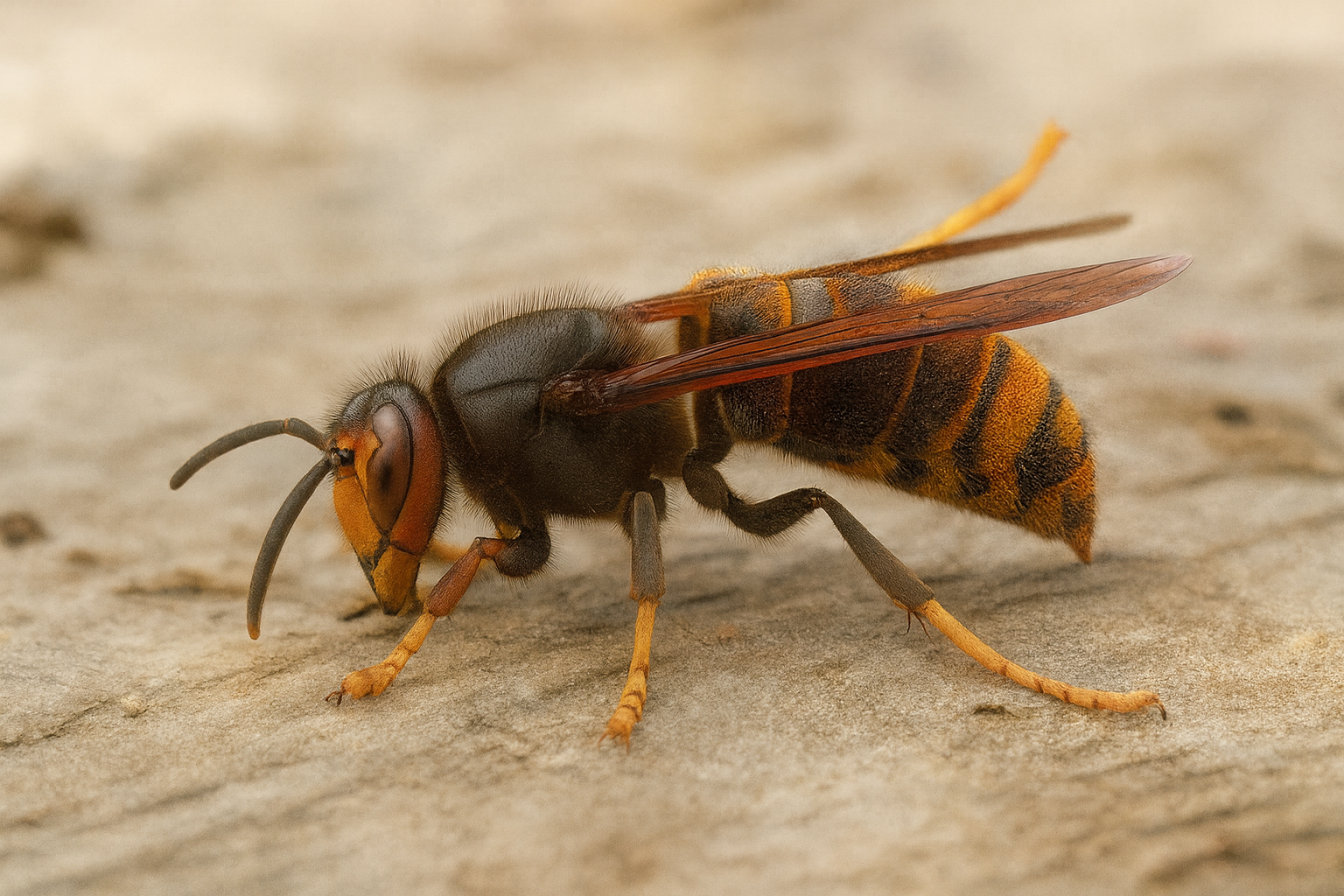
Asian hornet side view showing yellow legs and dark abdomen with an orange band

Asian hornet (Vespa velutina) – dark body, orange band on the abdomen, yellow leg tips.

At a glance

The Asian hornet is mainly recognised by its dark colours, its orange band on the abdomen and its yellow legs. The cards below summarise the most reliable features.

Size
  • Workers: approx. 2 to 3 cm
  • Queen: up to 3–3.5 cm

Larger than a wasp, but generally smaller and slimmer than the European hornet.

Body colours
  • Thorax: very dark brown, almost black
  • Abdomen: dark with a clear orange band

Overall darker than the European hornet (bright yellow abdomen).

Legs
  • Dark brown base
  • Bright yellow tips (“yellow legs”)

One of the best clues to confirm the presence of an Asian hornet.

Behaviour
  • Hovering in front of hives to catch bees
  • May gather in numbers around an apiary

Systematic predation of bees in front of hives is characteristic.

Differences between Asian and European hornets

Two hornet species can be observed in Belgium: the Asian hornet and the European hornet, a protected local species. The visual below summarises the most important differences to remember.

Overview
Comparative image of Asian hornets and European hornets

Left: Asian hornets (dark bodies, yellow legs). Right: European hornets (lighter, bright yellow abdomen).

Species
Asian hornet
2–3 cm (workers) Invasive species

General appearance: dark body, orange band on the abdomen, yellow legs.

Remember: dark abdomen + clear orange band + yellow leg tips.

Species
European hornet
Up to 3.5–4 cm Protected local species

General appearance: lighter, yellow abdomen with black markings, more massive.

Remember: lighter colour, bright yellow abdomen, important ecological role.

Recognising an Asian hornet nest

Asian hornet nests are built from “papier-mâché” made from wood fibres. Their appearance changes throughout the season.
Primary Asian hornet nest under shelter

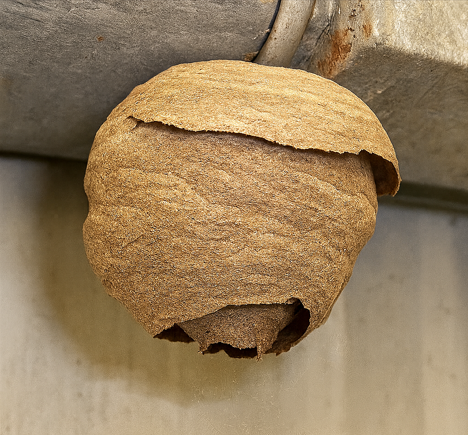
Primary nest, often under shelter (garage, roof edge, shed…).
Spring
Primary nest
Small size

Size: from a tennis ball to a small melon.

Typical location: under a roof, in a shed, in a hedge or under a slab.

  • Built by the queen early in the season.
  • Opening usually facing downward or sideways.
  • Often easier to reach and neutralise early in the season.
Secondary Asian hornet nest high in a tree

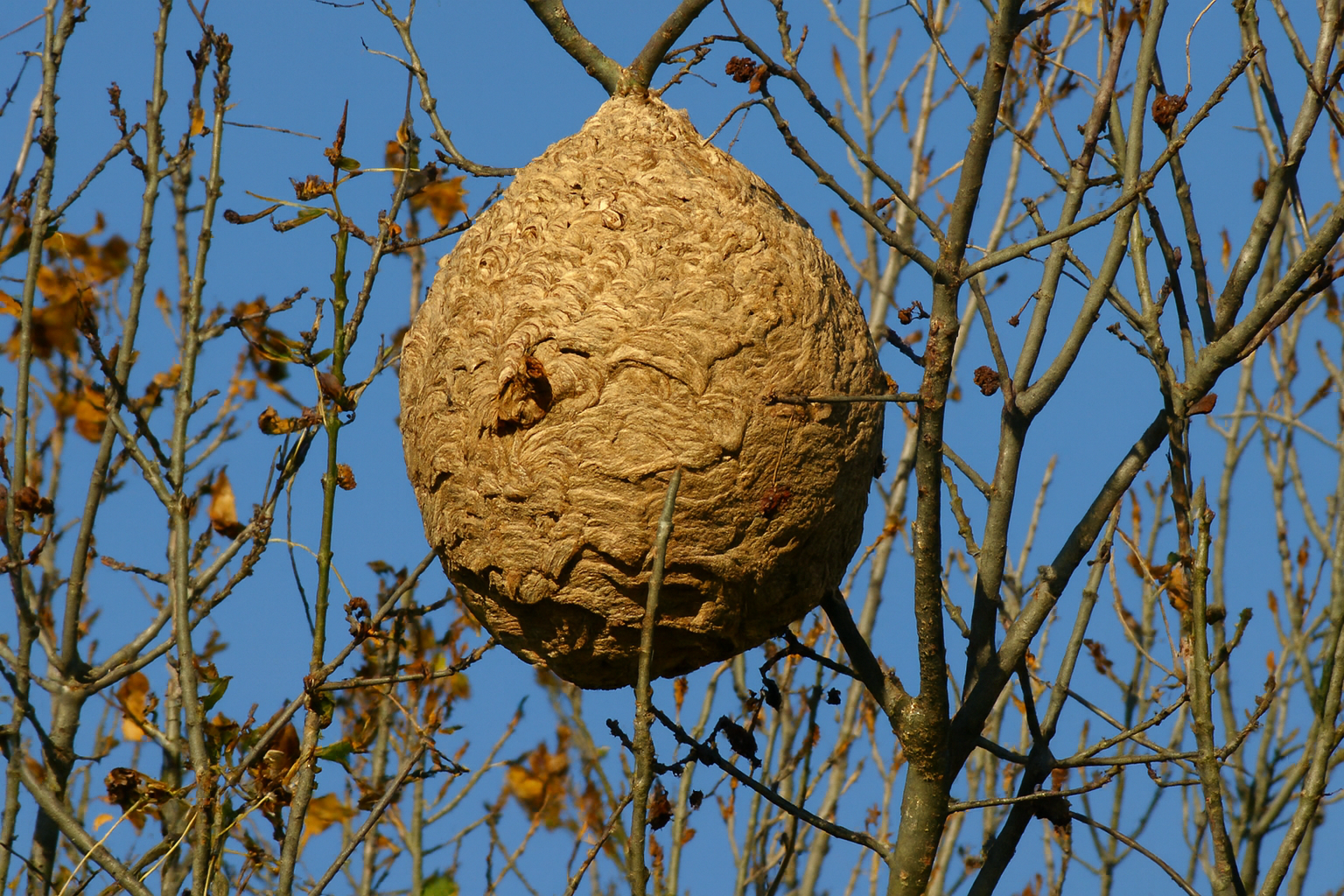
Secondary nest, often high in trees or on buildings.

Summer – autumn
Secondary nest
Very large size

Size: can reach 60–80 cm in diameter.

Typical location: high in trees, large bushes, façades or elevated structures.

  • Beige/grey colour, characteristic layered surface.
  • Large hornet population; strongly defended nest.
  • Often visible late in the season when leaves fall.
Do not attempt to approach or destroy an Asian hornet nest. Hornets defend the nest aggressively within a radius around it. Any intervention must be carried out by trained people.

Behaviour and public safety

Asian hornet behaviour
  • Mainly attracted to insects (including bees) and sugar sources.
  • Less attracted to human food than wasps, but may visit ripe fruit.
  • Aggressive near the nest.
What to do if you see one?
  • Stay calm; do not try to catch or kill it.
  • Move away calmly if you think you are close to a nest.
  • Note the location, date and approximate number of individuals.
  • If possible, take a photo from a reasonable distance.
What to do if you spot a nest?
  • Do not intervene yourself.
  • Avoid disturbing the nest (throwing stones, vibrations, etc.).
  • Report the situation via the Vespa Alert Belgium platform.

Three key points to remember

  • Colour: dark hornet, yellow legs, orange band on the abdomen.
  • Behaviour: mainly feeds on insects, vigorously defends its nest.
  • Reflex: do not intervene, take a photo if possible, then report it via Vespa Alert Belgium.